
No future without education!
Since its founding 25 years ago, the Global Campaign for Education has worked on all national, regional, and international fronts to call on States to fulfill their obligations regarding the right to education.
By its enabling nature, education is indispensable for the realization of all human rights and therefore constitutes the basis for development and is the first condition for people to learn to live collaboratively in peace and equality. It is essential to tackle the root causes of conflicts and disasters, to strengthen democracies, as well as economic, gender and environmental justice.
Since the announcement of the Summit of the Future (SOTF), the Global Campaign for Education has recognized the importance of the initiative and has been calling on UN member states, especially the representatives of Namibia and Germany, facilitators of the event, to include substantial education and lifelong learning commitments, acknowledging its transformative potential to present and future generations.
Regrettably, the scope and approaches proposed for the SOTF did not properly include the right to education, despite constant calls from civil society to include it in the official program, as well as in its outcome documents, the Pact for the Future, the Declaration on Future Generations, and the Global Digital Compact.
Indeed, some of these documents mention education narrowly without developing its scope aimed at transforming global governance in the medium and long term and, more importantly, achieving international peace and security.
While GCE recognises and supports the Human Rights International Framework and the Sustainable Development Agenda, we also stress that progress in their realisation cannot be possible without education and lifelong learning.
The Global Campaign for Education deeply regrets that the UN member states missed the opportunity to strengthen the educational dimensions in the important topics included in the Pact for the Future, and thereby failed to refer substantially to the societal foundations essential to ensuring peace, justice, democracy, and equality, which can only be built through education.
Addressing the necessary conditions for sustainable development cannot be casuistic, but rather comprehensive and coherent. By ignoring the construction of learning in the agenda proposed by the SOTF, we all missed the main ingredient for leading the urgent changes the world needs to overcome the crises of our days.
In addition to that, it is also a reason for concern that the Pact for the Future does not explicitly outline the responses and actions required from states and the international community to advance the issues it raises.
These limitations resonated with the obstacles faced by Major Groups and other Stakeholders in participating in the organization of the summit, whose functions have been undermined by the so-called Impact Coalitions. These coalitions were not set up as inclusive spaces and could expand the corporate and anti-rights capture of the UN.
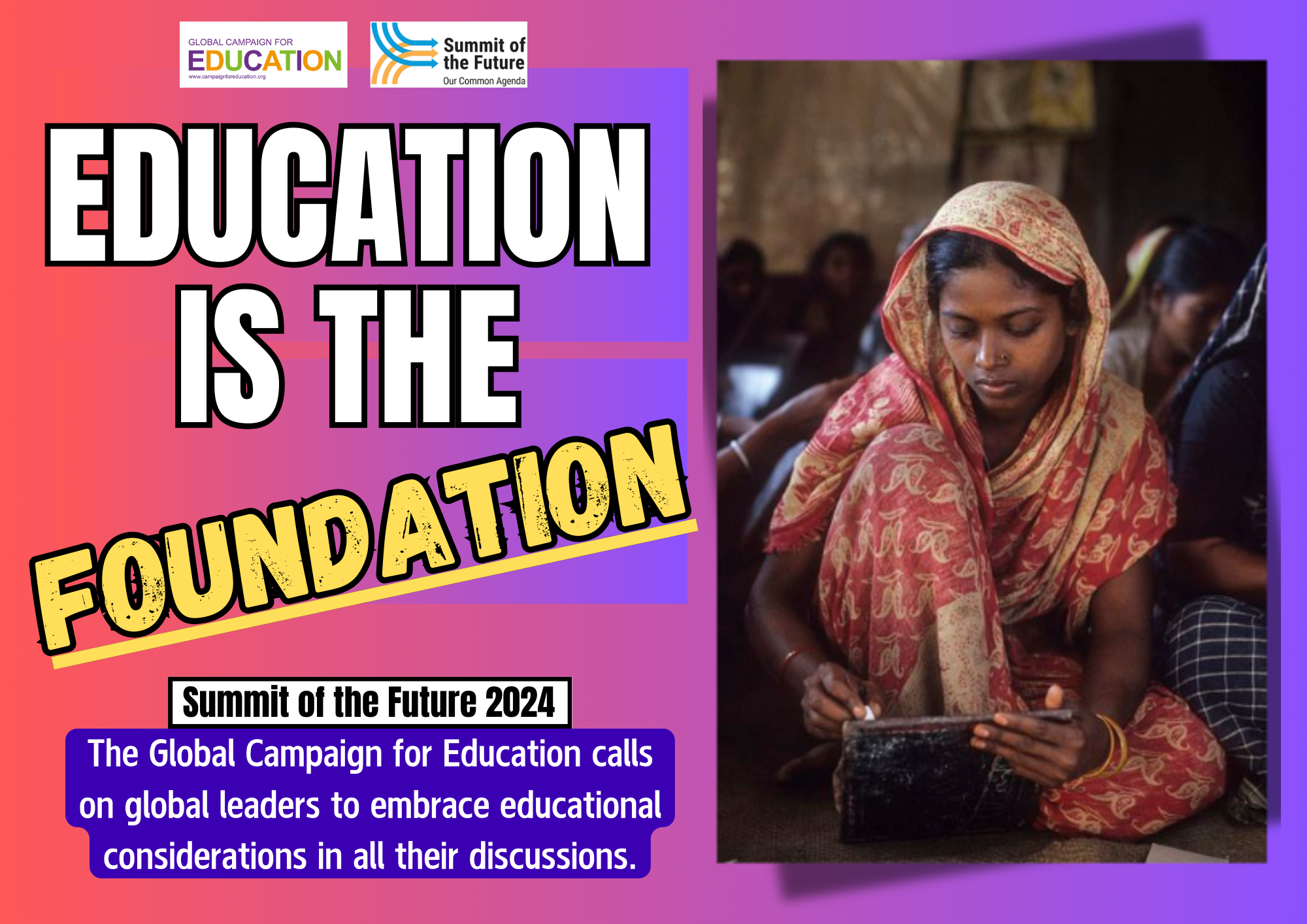
The Global Campaign for Education calls on global leaders to embrace educational considerations in all their discussions and resolutions on sustainable development, equality, peace, security and people’s participation in global governance.
A future without education is a return to the past.