
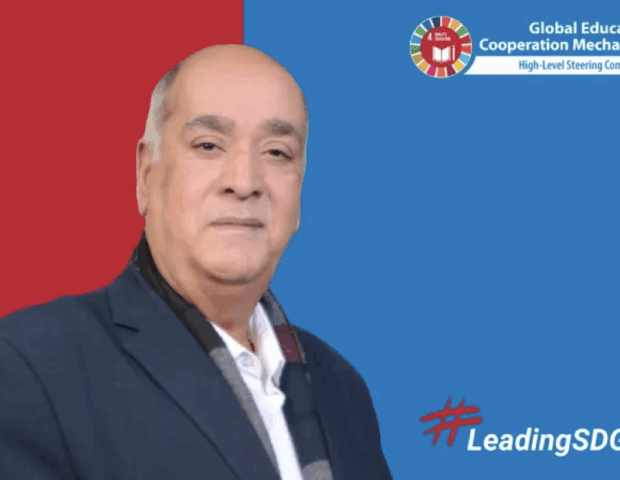
By Refat Sabbah, President of Global Campaign for Education and member of the SDG4 High-Level Steering Committee
When reflecting on the progress toward SDG 4, the five years left to 2030, and the vision that should guide us beyond, it is important to recall that civil society and education movements have always aimed for more than recording numbers or celebrating percentages. Our ambition has been to create a sense of safety and dignity for millions of children and youth on the verge of being left behind—those pushed to the margins of the world, not by choice, but because their vulnerability was manufactured by political decisions.
Justice in education cannot be confined within narrow national boundaries. It must be upheld as a global commitment, especially by wealthy nations, which cannot turn a blind eye to their responsibilities toward marginalized learners in the Global South. These responsibilities include protecting them from conflicts and disasters and shielding them from exploitation by predatory systems that thrive on profit while evading fiscal duties at the expense of children’s futures.
At the heart of our vision stands the teachers. We affirm this clearly and without hesitation: no educational reform can succeed unless teachers are respected, supported, and secure. They are the cornerstone of any just and sustainable transformation.
As we approach 2030, we acknowledge that progress has been made. Enrollment rates have risen, efforts to improve quality have gained momentum, and notable steps have been taken to integrate technology and digital learning. Yet this progress remains inequitable.
When it comes to education financing, the road is still long. Despite the effort of important initiatives like Education Cannot Wait and the Global Partnership for Education, no breakthrough has matched the scale of the crisis—especially in fragile and marginalized contexts. Low- and lower-middle-income countries face an annual financing gap of at least USD 97 billion to meet SDG 4 targets by 2030, and many of the poorest nations still rely heavily on external support.
Meanwhile, official development assistance (ODA) for education has been declining, while global military spending soars—reaching an all-time high of USD 2.44 trillion in 2023, a 6.8% increase from the previous year. This stark imbalance is deeply unjust: even a fraction of military resources could transform public education systems worldwide. At the same time, revenue lost to tax evasion could employ millions of teachers and build thousands of schools. The gap between what is available and what is allocated to education reveals a profound flaw in our collective priorities.
In times of crisis and conflict, education has too often been treated as secondary to immediate relief, disregarding its vital role in recovery and resilience. It is still not sufficiently integrated into emergency responses, as if it were a luxury rather than a right.
Education cannot be separated from broader goals of development and justice. It is inextricably linked to ending poverty and hunger, ensuring health and equality, combating climate change, preventing wars, and upholding human rights. Education lies at the heart of the new global social contract—the one that must protect us from sliding into barbarism or justifying violence under false notions of legality or morality.
This requires redefining the concepts that shape our vision of education, foremost among them the very concept of the human being. Without a clear and grounded understanding of what it means to be human and of the rights this entails, we will remain trapped in cycles of racism, exclusion, and the moral justification of violence under deceptive banners.
The proposed vision seeks to contribute to a new social contract for education by redefining it as a deeply human and value-based endeavor, intrinsically linked to the full recognition of human dignity and rights—not merely economic utility. Education must not be neutral or detached from politics and society. It must be a tool for shaping critical consciousness, resisting authoritarianism, hatred, and violence, while promoting justice, solidarity, and environmental responsibility. The vision holds current systems accountable for failing to respond to the climate crisis and for neglecting moral and democratic values under the dominance of neoliberal policies.
At a time of rising populism and declining trust in democratic institutions, the vision affirms that education must liberate consciousness and build active, responsible individuals capable of positive change. It emphasizes lifelong learning, vocational pathways, the removal of structural barriers for marginalized groups—especially women, girls, and refugees—and the empowerment of teachers through training and recognition.
Finally, the vision critiques the reduction of education to labor-market preparation at the expense of holistic human development. This has marginalized the humanities and stripped education of its ethical and spiritual dimensions. What is needed are curricula that restore balance between technical skills and moral values, foster critical thinking, and help learners understand themselves, their relationships with others, and their place in the world.
Disclaimer: This blog section features insights and ideas from the SDG4 High-Level Steering Committee members and other education partners on transforming education and leading SDG 4. The opinions expressed are those of the authors alone.
Click HERE to read this blog on the UNESCO website.